The Prepping Procedure
Prepping the surgical site should be the last step before the surgical team scrubs in. The anesthesiologist must have all lines and monitoring equipment secure and ready, and the patient must be appropriately positioned and secured before prepping can occur.
Depending on the area, it is recommended to place blue pads/absorbent materials at the edge of the prep sites to catch any runoff of the prep solution and to avoid pooling. These pads should be removed once prepping is completed.
The solution should be applied in a way that prevents pooling in:
- Skin folds
- Underneath the patient or positioning equipment
- Underneath a tourniquet or electrosurgical dispersive pad, or monitoring electrodes
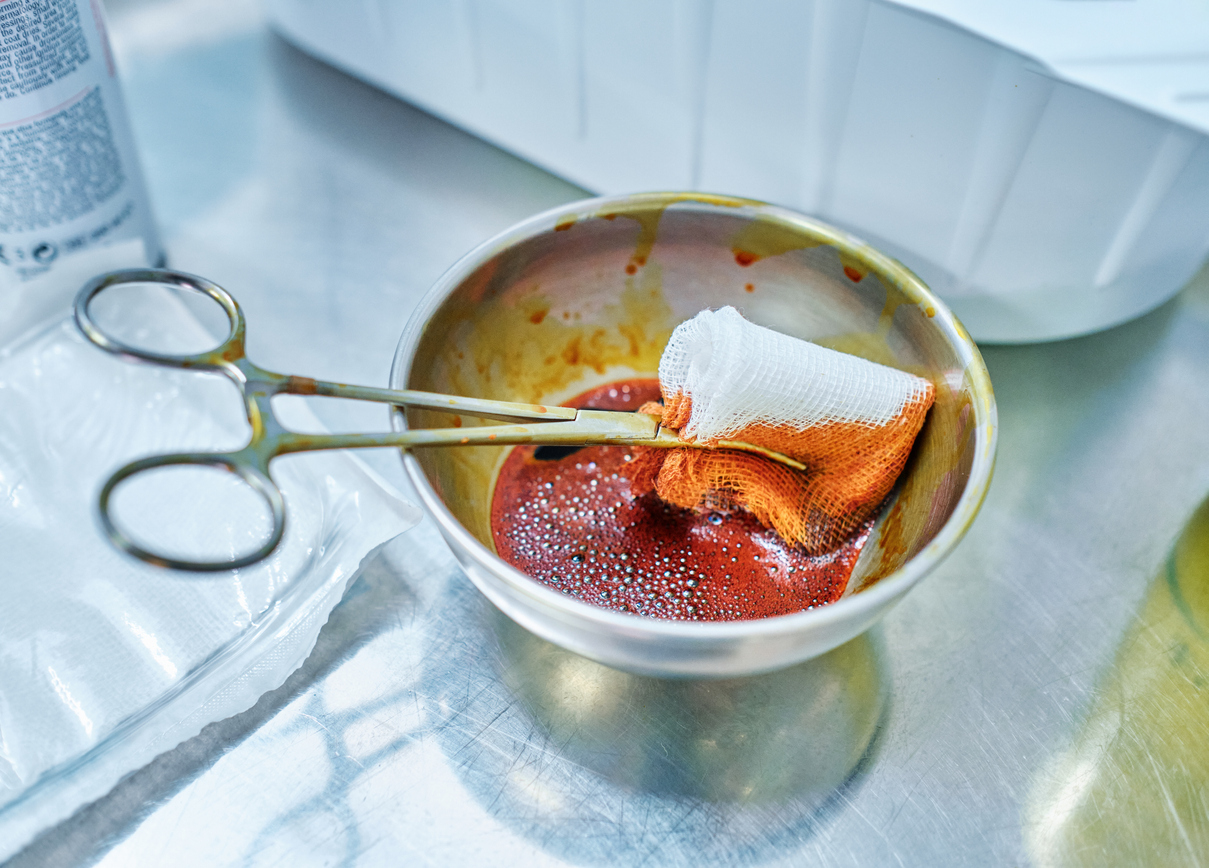
The perioperative person performing the prep should be nonsterile (i.e., not scrubbed in) and should wear nonsterile gloves. They should use an instrument such as a prep stick or an applicator with a long enough handle that they do not touch the prep solution.
It is recommended that sole-use prep sponge packages, applicators or solution containers be used to decrease the risk of cross-contamination.
The perioperative personnel performing the prep should follow the manufacturer’s guidelines for application. General considerations for all prep include:
- Prep from clean (incision area) to dirty (peripheral area).
- Prep an area larger than what is required for the surgical site. This is important to allow for the enlargement of an incision, insertion of drains, and insertion of additional ports, for laparoscopic procedures.
- When the entire area is prepped, note the time, and ensure that the manufacturer’s drying guidelines are adhered to before placing surgical drapes.
Skin Preparation Portal
See an example of how to prep should be administered for an abdominal procedure.
Visit Portal
(ORNAC, 2021)
Exceptions When Prepping
For abdominal surgery including the umbilicus, the umbilicus should always be cleaned/prepped first.
If in an abdominal/perineal combined surgery, the incision/operative area involves multiple areas that are known to have a high bacterial load like the vagina or anus, these areas should be prepped first. However, a new skin prep should be used for the second abdominal area so as not to transfer microbes to an area with a lower bacterial count.
Surgical procedures that involve an abdominal prep with a stoma present:
- A povidone-soaked sponge and clear adhesive dressing should cover the stoma.
- Prep the abdomen normally with chlorhexidine and allow it to dry.
- When dry, remove the clear dressing, and sponge from the stoma, and prep the site with povidone. Allow it to dry and cover it with a clear sterile adhesive dressing.
💬 Communication Highlight
Most prep solutions contain agents that are flammable until dry. It is vital that the perioperative team communicate the time of prep completion so that the manufacturer’s guidelines can be followed for drying.
Some facilities start a timer once the prep is completed so that all staff are aware of the wait time required prior to placing surgical drapes.
While the prep solution is drying, the surgical team often leaves the room to scrub. The perioperative nurses are responsible for monitoring the surgical site and communicating with all other team members. They must ensure that the site does not get contaminated.
📁 Documentation Highlight
It is essential that the perioperative nurse document the following information regarding skin prep:
- The condition of the operative site is not healthy or intact.
- The method of hair removal.
- The name and concentration of the antiseptic agent.
- Skin reaction, if any.
- Name of the person performing the prep.
All prep solutions must be clearly documented in the patient’s chart. This is for quality assurance performance tracking and to clearly record the solution used in case of a reaction.
(ORNAC, 2021)
🧠 Graded Activity
In Blackboard complete the Graded Activity: Preparation solutions.
📽️ AORN CINE-MED VIDEO
Navigate to the AORN Cine-Med website and make sure that you are logged in before clicking on the link below.
- Watch the AORN Cine-Med Video on Preoperative Skin Antisepsis. You can check out specific prepping methods for various procedures.
- Download the included Study Guide to follow along.
- (Thread to follow in Cine-Med – Aseptic practices Preoperative Skin Antisepsis)
- Runtime – 37 minutes