Phases of Wound Healing
When a wound is present, the human body goes to great lengths to restore skin integrity and protect itself from fluid loss and potential pathogens. There is a set process for wound healing, which includes these phases:
(Bak, 2019)
Factors Affecting Wound Healing
There are numerous factors that can affect a wound’s ability to heal. Some include:
- Surgical site infection (SSI)
- Patient susceptibility
- The severity of the illness
- Microbial contamination by the patient’s microflora
- Exogenous wound contamination
- Surgical technique
- The patient’s nutritional status
- Oxygenation levels of the surrounding tissue
- Hypothermia in the patient
Surgical Methods of Wound Closure
Wounds can be closed surgically using sutures, staples, or skin adhesives. Each method has its own advantages and disadvantages:
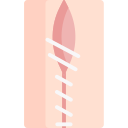
Suture material

Staples

Skin adhesives
Suture Characteristics and Types
Sutures are the material used to close and approximate wounds, which promote healing and reduce infection risk.
- A ligature or tie refers to suture material used to prevent bleeding by tying off and occluding blood. It can also isolate tissue to be excised.
- A free tie refers to a single strand used by the surgical team to ligate a blood vessel.
Suturing refers to the act of sewing and approximating tissues by bringing them together. Suture material has three distinctive characteristics — physical, handling, and tissue retention. Suture selections are determined by the wound location, type of repair and patient attributes.
🧩 Practice Activity: Physical Characteristics
Complete the activity by dragging the text block into a drop zone. Select “Check” when you feel confident in your answer(s).
🧩 Practice Activity: Handling Characteristics
Complete the activity by dragging the text block into a drop zone. Select “Check” when you feel confident in your answer(s).
Tissue-Reaction Characteristics
Since the suture is made of foreign material, there will be some tissue reaction. This begins at the time the suture penetrates the tissue. The inflammation continues until the suture is encapsulated for non-absorbable sutures or absorbed for absorbable sutures. Types of reactions:
- Inflammatory and fibrous cell
- Absorption
- Potentiation of infection
- Allergic
(Cromb, 2019 & Phillips, 2020)
🧩️ Practice Activity: Suture Material
Create a chart to help with your learning.
Download/print the chart (Practice Activity: Suture Material Chart (DOCX)) in Blackboard and fill in the blanks as you learn about various suture materials. This will help you make sense of the most common suture materials used in the operating room environment.